Tap Rush Madness
A lightning-fast mini-game collection that tests your reflexes, memory, and precision
1. Project Overview
Tap Rush Madness is a collection of fast-paced mini-games designed to challenge players' reflexes, memory, and precision through fun and engaging gameplay.
This web application targets casual gamers and anyone looking to test and improve their reaction time through quick gameplay sessions. It addresses the need for accessible, browser-based games that can be enjoyed in short bursts without requiring downloads or installations.
As the solo developer on this project, I handled all aspects from concept and design to implementation and testing.
2. My Role
I served as the sole developer and designer on this project, handling all aspects including:
- Game concept and mechanics design
- User interface design and implementation
- Front-end development using React and TypeScript
- Animation and interactions using Framer Motion
- Performance optimization and testing
Tools used: React, TypeScript, Framer Motion, Tailwind CSS, Figma for initial wireframes
3. The Challenge
This project began as a personal challenge to create an engaging browser-based game that could test and potentially improve players' reflexes and cognitive abilities.
The main challenges included:
- Creating gameplay that's simple to understand but difficult to master
- Designing four distinct mini-games with varying mechanics but a cohesive feel
- Implementing precise timing mechanics for accurate reflex measurements
- Ensuring the game runs smoothly across different devices and browsers
- Making the game visually appealing and satisfying to play
4. Research & Discovery
User Personas
Casual Gamer Casey
- Age: 18-35
- Occupation: Student/Professional
- Pain Points: Limited time for gaming, doesn't want to install applications
- Goals: Quick entertainment during breaks, something fun to do on mobile
Competitive Taylor
- Age: 16-40
- Occupation: Varied
- Pain Points: Wants to improve reflexes for other games, needs measurable progress
- Goals: Beat personal records, challenge friends, improve reaction time
Competitive Analysis
I analyzed several reflex-based games and applications to understand market offerings:
- Human Benchmark: Focuses on clinical measurement but lacks game-like engagement
- Mobile reflex games: Fun but require downloads and often filled with ads
- Browser mini-games: Often simple with limited variety
Tap Rush Madness differentiates by offering multiple game modes in one web-based application with an emphasis on both fun and skill development, without requiring installation or dealing with ads.
5. Ideation & Strategy
The design approach for Tap Rush Madness was guided by these principles:
- Accessibility: Games should be immediately understandable
- Satisfaction: Actions should provide immediate visual and auditory feedback
- Challenge: Difficulty should increase naturally as players improve
- Variety: Different game modes should exercise different cognitive skills
Through brainstorming sessions, I explored different game mechanics and settled on four distinct but complementary mini-games that would challenge different aspects of reflexes and cognition.
6. Information Architecture & User Flow
The application is structured with simplicity in mind:
Key User Journey
Home Screen
Game selection & instructions
Game Mode
Player interacts with chosen mini-game
Results Screen
Score, stats & replay option
Return to Menu
Select another game or retry
Design decisions around structure included:
- A central hub for game selection rather than separate pages to reduce navigation friction
- Clear, simple instructions displayed before each game begins
- Consistent UI elements across games (timer, score, feedback indicators)
- Single-tap navigation to minimize interaction barriers
7. Design & Prototyping
UI Design
Color Palette
Vivid colors were chosen for clear visual feedback and to create excitement during gameplay
Typography
Game Title
Instructions Text
Score: 1250
Large, clear typography ensures readability during fast-paced gameplay
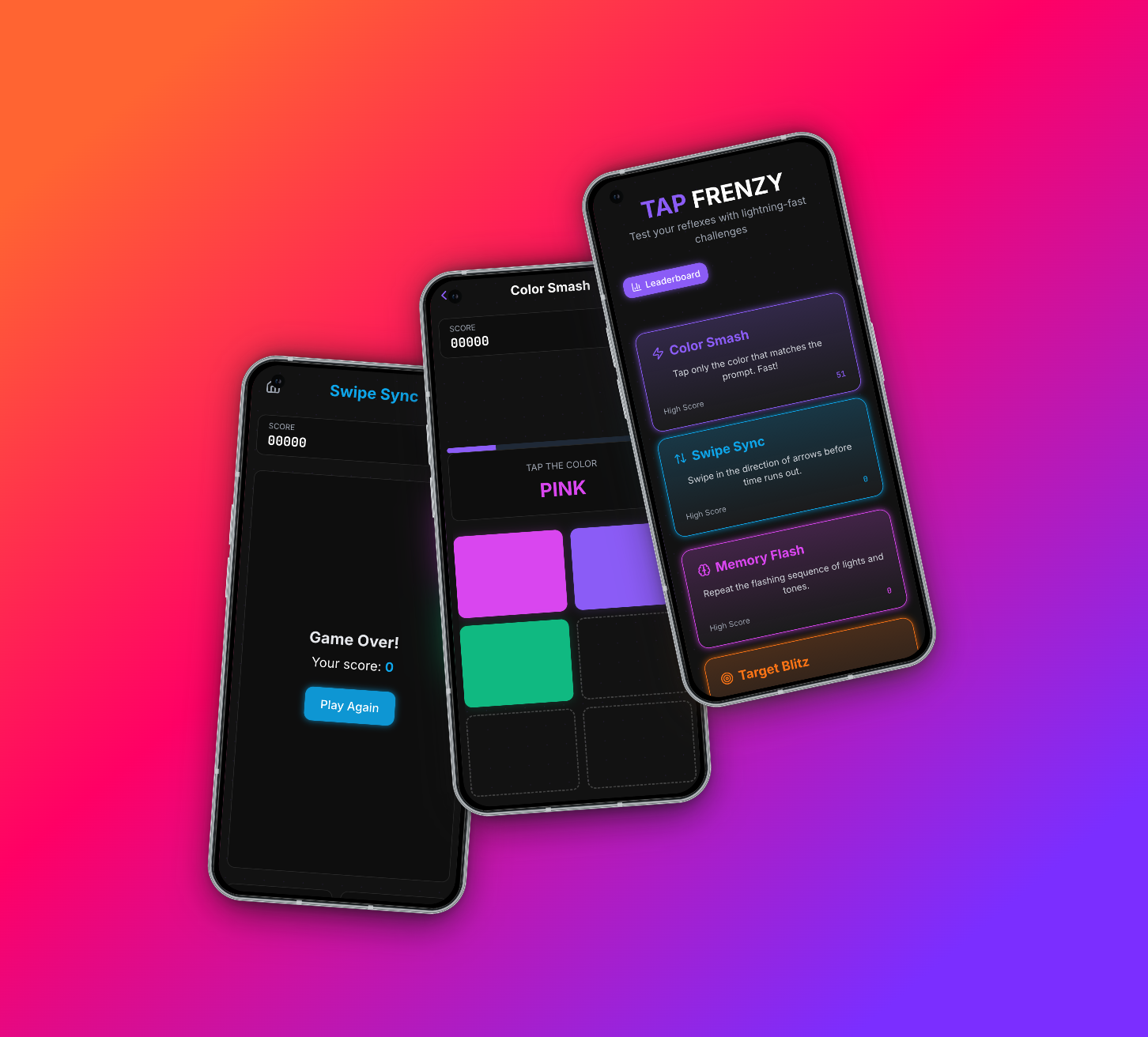
Game Screens
Accessibility Considerations
- High contrast colors for visual clarity
- Large touch targets for easier interaction
- Both visual and audio feedback for actions
- Simple, straightforward instructions
8. Prototypes & Interactions
The interactive nature of Tap Rush Madness is central to its appeal. Key interactions include:
- Color Smash: Tiles change color with smooth transitions and provide haptic feedback when tapped
- Swipe Sync: Directional arrows appear with animation and respond to swipe gestures
- Memory Flash: Tiles illuminate briefly and respond to player's memory recall
- Target Blitz: Targets appear with scaling animations and disappear with satisfying pop effects
9. Testing & Feedback
Testing for Tap Rush Madness went through several phases:
Initial User Testing
Five test users played early versions of the games, providing the following insights:
- Users found the Color Smash game too difficult at first; adjusted the timing and color contrast
- Memory Flash confused some users; added clearer instructions and visual cues
- Target Blitz had inconsistent difficulty; implemented progressive difficulty scaling
- Users wanted to see their previous scores; added persistent high scores
Feedback Implementation
Before
- No countdown before game starts
- Minimal instructions
- No score history
- No visual feedback for correct/incorrect actions
After
- Added 3-2-1 countdown animation
- Enhanced instructions with examples
- Implemented score history and personal bests
- Added clear visual and audio feedback
10. Outcome / Impact
Tap Rush Madness has been launched as a fully functional web application accessible to players across different devices.
Results
- Positive feedback on the application's responsiveness and feel
Key Takeaways
- Visual feedback is crucial for reflex-based games
- Progressive difficulty helps maintain player engagement
- Multiple game modes increases replay value significantly
- Browser-based games need to be extremely responsive to feel satisfying
11. Reflection
What Worked Well
- The variety of game modes kept the experience fresh
- Framer Motion animations created a polished feel
- The simple UI allowed users to focus on gameplay
- Progressive difficulty kept players challenged
What Could Be Improved
- Adding user accounts for persistent progress
- Implementing global leaderboards for competition
- Creating more game modes to expand variety
- Optimizing performance further for lower-end devices
Growth as a Developer
This project pushed me to improve in several areas:
- Deeper understanding of animation performance in React
- Better techniques for timing-sensitive interactions
- Improved approach to gathering and implementing user feedback
- Greater appreciation for accessibility in game design
Next Steps
Tap Rush Madness continues to evolve with planned features including multiplayer challenges, additional game modes, and mobile app versions coming in future updates.